“It does not matter how slowly you go as long as you do not stop.”
— Confucius (551–479 BC), Chinese philosopher
We often hear the same observation from teachers regularly: the upper intermediate level consistently produces some of the most frustrated learners and the most uncertain teachers. Students at this stage can handle daily interactions, follow most conversations, and read English competently. What they often cannot yet do is speak at length, with precision, on topics that require extended reasoning and nuanced vocabulary.
A well-designed upper intermediate ESL speaking book may address this plateau directly. This blog examines what tends to make the upper intermediate level uniquely challenging, how a speaking-focused text differs from a general intermediate grammar resource, and what learners and teachers might reasonably expect from conversation-centered instruction at this stage.
Why Does the Upper Intermediate Plateau Feel So Difficult to Break Through?
The upper intermediate plateau describes a well-documented stage in second language development where measurable progress slows despite continued study. Learners at this level can communicate functionally. They can buy groceries, follow a lecture, and write a competent paragraph. What they often cannot yet do easily is participate in fast-moving group conversations, produce extended spoken argument, or recover smoothly when they lose the conversational thread.
This fluency gap persists partly because the most common remedies at this level, additional grammar review and reading comprehension work, address skills that upper intermediate learners have often already developed adequately. What they tend to lack is precisely what grammar-focused instruction rarely provides enough of: sustained, varied, meaningful speaking practice at a level of complexity that genuinely stretches their current capacity.
Stephen Krashen, who taught at the University of Southern California, identified this dynamic in his Input Hypothesis: acquisition may proceed most effectively through input slightly beyond the learner’s current level, enough to challenge without overwhelming. For upper intermediate learners, this suggests conversation tasks on topics complex enough to require extended reasoning rather than simple personal description.
What Makes an Upper Intermediate ESL Speaking Book Different from a General Textbook?
A general intermediate ESL textbook covers grammar, reading, writing, listening, and speaking as roughly equal components. An upper intermediate ESL speaking book inverts that balance: speaking drives everything. Grammar, vocabulary, and writing tasks all serve the primary goal of extended oral English production.
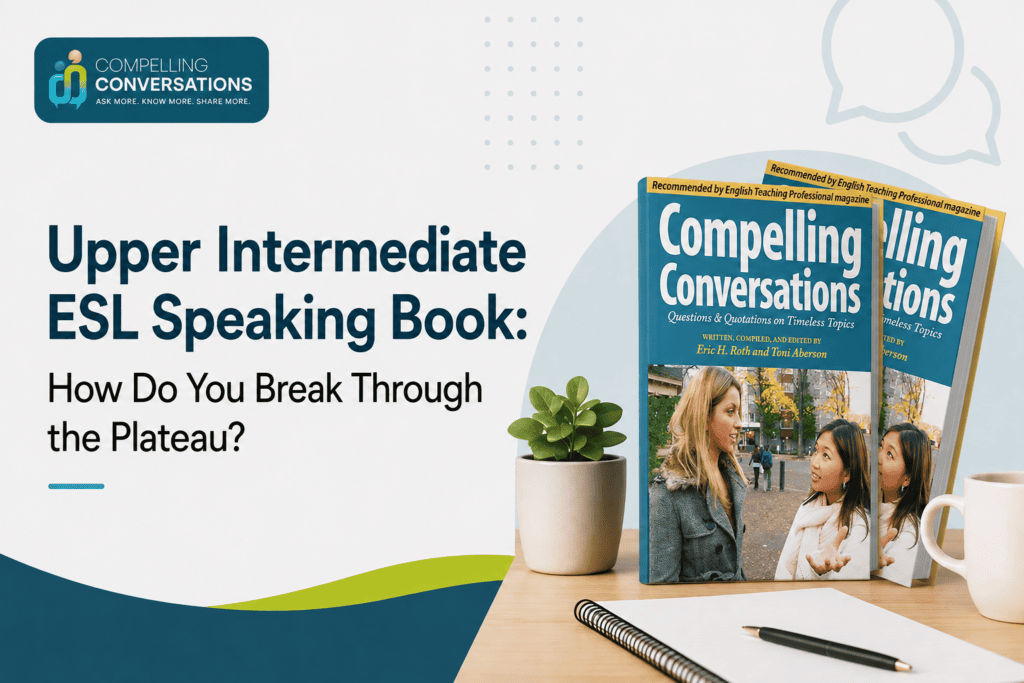
In Compelling Conversations, the design logic applies across all 45 chapters. Each self-contained chapter gives upper intermediate and advanced learners a topic, layered discussion questions that progress from accessible personal prompts to more reflective and analytical ones, authentic quotations from writers and historical figures, and proverbs from multiple cultural traditions.
These features give upper intermediate learners multiple entry points into each discussion. A learner who may struggle with the more complex analytical questions can still contribute meaningfully to the personal and comparative prompts. A stronger learner in the same session engages with the more nuanced questions without the class holding them back. Visit compellingconversations.com/compelling-conversations to explore the full chapter structure.
In Compelling American Conversations, the same speaking-centered design focuses specifically on American cultural context, helping upper intermediate ESL and EAL learners navigate the idioms, cultural references, and conversational norms of everyday American life while developing their fluency. Find out more at compellingconversations.com/compelling-american-conversations.
How Does an Intermediate ESL Conversation Textbook Balance Fluency and Accuracy?
An intermediate ESL conversation textbook walks a specific tightrope. Lower-intermediate learners need significant scaffolding: sentence starters, vocabulary support, and tightly controlled topic ranges. Advanced learners need the opposite. Upper intermediate materials sit between these poles, offering enough structure to support learners while leaving enough openness for genuine extended speaking.
This balance in practice often looks like structured partner questions in the warm-up, more open group discussion in the main activity, and a brief reflection or vocabulary debrief at the end. This session structure gives learners support without constraining the conversation to scripted exchanges.
Grammar accuracy at the upper intermediate level matters in a specific way. Persistent errors that interfere with meaning may deserve attention. Errors that do not interfere with meaning, including occasional article omissions, mixed-up countable and uncountable nouns, or minor tense inconsistencies, rarely warrant mid-conversation interruption. Teachers who note these patterns and address them briefly after the discussion runs its natural course tend to protect both the learner’s confidence and the speaking time that fluency development requires.
The Teacher Tips for Conversation Classes section on our site offers specific guidance on managing this balance in upper intermediate speaking classes.
Which Topics Most Effectively Push Upper Intermediate Learners Forward?
Topics that connect to adult experience and require comparative or analytical thinking tend to produce the most productive discussion at the upper intermediate level. In chapters on Work Relationships, Handling Stress, Coming to America, and Searching for Heroes, learners encounter substantive, personally relevant material they find worth discussing at length.
Topics that allow for personal storytelling tend to produce longer utterances than purely analytical topics. Upper intermediate learners who narrate their own experience in English naturally push their vocabulary and sentence structure further than when producing short factual answers. This narrative dynamic may generate ten minutes of genuine speaking from a single learner, far more valuable practice than ten short answers to ten separate questions.
The Compelling Conversation Starters page on our site offers additional topic prompts suitable for upper intermediate learners in classroom, tutoring, and conversation club settings.
How Can Upper Intermediate Learners Use Conversation Practice to Prepare for Advanced Study?
Upper intermediate conversation practice may help build the vocabulary, argumentation habits, and extended speaking confidence that advanced academic and professional English requires. A learner who regularly discusses Voting and Choosing Leaders, Crime and Punishment, or Practicing Job Interviews in English develops the register, the reasoning vocabulary, and the comfort with complexity that college coursework, graduate programs, and professional workplaces tend to demand.
Many teachers find that using conversation discussions at this level to introduce writing assignments works well. This speaking-first approach generates vocabulary and positions that learners can carry directly into an essay, lowering the cognitive load of writing by making the language feel already familiar from spoken use.
ESL, EFL, EAL, and MLL learners at the upper intermediate level who consistently practice speaking on complex topics tend to outperform those who receive primarily grammar-based instruction in oral proficiency assessments, according to research from the American Council on the Teaching of Foreign Languages. (Source: ACTFL, actfl.org)
Breaking Through the Plateau Requires the Right Materials and Consistent Practice
At Compelling Conversations, we design materials specifically calibrated to push upper intermediate and advanced ESL, EFL, EAL, and MLL learners forward through consistent, structured speaking practice on topics that respect their intelligence and their life experience.
Contact us through our contact page or call 1-855-375-2665 (US/Canada) and 1-310-390-0131 (outside the US) to find the title that best fits your upper intermediate program.
Frequently Asked Questions
- How do you know when a learner has moved past the upper intermediate plateau?
Sustained ability to hold extended conversations on unfamiliar topics, without frequent pausing or code-switching, generally tends to signal the transition to advanced fluency. This conversational range also marks the shift.
- Does an upper intermediate speaking book work alongside a core grammar textbook?
Yes. In Compelling Conversations, the materials work effectively as a supplement to a core grammar curriculum, providing the extended speaking practice that grammar-focused texts rarely include in sufficient quantity.
- How long does it typically take an upper intermediate learner to develop advanced fluency?
With regular conversation practice three or more times per week, many upper intermediate learners notice significant fluency gains within three to four months. This timeline varies with first-language background and speaking environment outside class.
- Can upper intermediate learners benefit from conversation clubs outside the classroom?
Regular participation in a structured conversation club or informal conversation cafe gives upper intermediate learners additional speaking practice that may compound the progress made in formal lessons.
- Are there specific chapter topics in Compelling Conversations that work particularly well?
In chapters on Work Relationships, Handling Stress, Coming to America, Crime and Punishment, and Searching for Heroes, upper intermediate learner groups tend to generate the most extended and linguistically rich discussion.