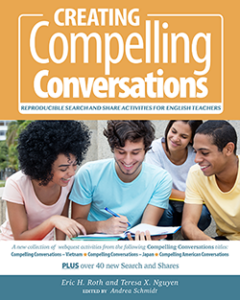
September 30th, 2008
Are you looking to share practical techniques with your fellow English teachers? What works in your ESL classroom? What tends to work in other ESL classrooms? Why?
The Los Angeles Regional CATESOL conference, titled “WWW. What Works and Why” at Biola University on October 25 features over 60 workshops and panel discussions. The annual event is expected to attract over 500 ESL professions from K-12 classes, adult education, IEP, and community college and university programs. CATESOL members receive a discount on the conference fee.
Do you live in Southern California? Do you have plans for October 25th yet? Visit
http://www.lacatesol2008.org/ if you are interested. This regional conference is larger than many state conferences and reflects the importance of studying English to immigrants in Los Angeles – especially during economically difficult times.
By the way, I will be giving a 45-minute presentation titled “Technique for a More Democratic Classroom” and a joint presentation titled “Creating Win-Win Workplace English Programs That Work for Both Employers and Employees.”
In my solo presentation, I will review classroom practices like tailoring assignments for individual students, effective peer evaluations, and organizing students to create classroom materials. Some exercises come from Compelling Conversations, but most exercises are practices that I’ve developed over time in both writing and speaking courses.
The second presentation, with Troy Parr, comes out of a series of vocational ESL workshops that we designed for an important union for healthcare workers, the SEIU, in Los Angeles. (The director of their workplace educational programs read Compelling Conversations., and contacted me. I brought in Troy, who wrote his thesis on best practices in workplace ESL programs.) We emphasize the importance of creating practical, participant specific exercises that both introduce new workplace vocabulary and provide many opportunities to speak, write, and reflect on workplace issues – in English. These workshop exercise such as rewriting forms, writing memos, and giving presentations on safety tips also help students develop their language skills for beyond their immediate job.
Naturally, I hope you can make the LA Regional CATESOL conference. See you there?
For more information:
http://www.lacatesol2008.org/
http://catesol.org
Ask more. Know more. Share more.
Create Compelling Conversations.
Visit www.CompellingConversations.com
Tags: adult education, adult ESL, CATESOL, Community College ESL programs, Compelling Conversations, EL/Civics, Eric Roth, IEP, LA Regional CATESOL conference, SEIU, Troy Parr, VESL, workplace communication skills, workplace English, workplace ESL, WWW. What Works and Why
Posted in CATESOL, California, Compelling Conversations, EL Civics, ESL, English class, Los Angeles, VESL, adult education, workplace communication skills | No Comments »
September 27th, 2008
Amazon lists over 5 million books on its website – and continues to overlook many fine self-published books. Naturally, as a self-publisher, Amazon represents an important outlet for my ESL conversation textbook, Compelling Conversations: Questions and Quotations on Timeless Topics. Besides, numbers add precision and ratings can become addictive.
Today Amazon has Compelling Conversations listed at 6,198! That’s my highest overall rating yet – and far better than my usual top 35,000 rating. The book is also rated #3 in the category “adult and continuing education”. Consider me satisfied and surprised.
For a small self-published author, selling a book around the world – and collecting favorable reviews from customers in Australia, Japan, and Spain is a simple pleasure. Amazon’s customer reviews have certainly helped promote the unusual conversation book aimed at sophisticated adults who want to bring their insights, wit and humor into more and deeper English language conversations. Besides my website, www.CompellingConversations.com that offers free sample chapters, Amazon remains my principal promotional tool. So the Amazon ratings and category rankings provide a way to measure success.
Of course, I remain curious about Compelling Conversations finding more success in adult education ESL programs than the flexible private language programs, university programs, and conversation clubs. Private schools, focusing on student desires and needs, usually provide smaller classes with more speaking opportunities. Further, the academic vocabulary appeals more to university bound or university trained adults. Compelling Conversations usually ranks higher in categories like “English as a Second Language”, “English as a Foreign Language”, “Teaching Methods”, “TOEIC”, and even “Quotes” than “Adult and Continuing Education.”
The popularity of Compelling Conversations also reflects an increasing awareness that adult education students want and need more speaking opportunities. Adult education programs, sometimes narrowly focused on a so-called life skills curriculum and preparing students for fill-in the blank mandated tests, offer few conversation classes. Why? Mostly because of the funding structure which doesn’t encourage specialized language classes. The large class sizes also limit the chances to speak – even in intermediate and advanced classes. Creative, dedicated adult education teachers have to make exceptional efforts to provide students with speaking skills – and many do so. Compelling Conversations helps busy adult education teachers supplement life skills lessons with energetic conversation activities.
Amazon updates their numbers every hour, and no doubt Compelling Conversations
will soon return to its usual ranking. Reaching the top 10,000 on Amazon may not sound like much to people who reduce all experiences to dollar signs. I made more money teaching Thursday than on my exceptionally successful Friday, but it provides a sense of being appreciated. Yet I’m counting this milestone as a personal victory, counting my blessings, and smiling.
Ask more. Know more. Share more.
Create Compelling Conversations.
Visit www.CompellingConversations.com .
Tags: adult education, adult ESL, Amazon ranking, Amazon reviews, Compelling Conversations, conversation classes, conversation textbook, EFL, EFL books, English tutors, ESL books, ESL resources, IEP programs, self-publishing, small personal victories, teaching ESL, TOEIC
Posted in California, Compelling Conversations, EFL, ELL, ESL, English class, IEP, academic matters, adult education, self-publishing, website | No Comments »
September 25th, 2008
Do American immigrants want to learn English? Are the children of Spanish-speaking adult immigrants learning English? What are the recent trends in California and Los Angeles?
A recently released Census Bureau report, based on the 2007 Census information, shows that – shock, shock – immigrants overwhelmingly want to improve their English skills. It also shows that a slight majority (51%) of immigrants in Los Angeles claim that they can speak English fluently – an increase from just a few years ago. The study also notes that 88% of immigrant children claim to speak English – and want to learn more.
Yesterday’s Los Angeles Times editorial “Speak English? Yes, more immigrants do “ provides a solid introduction to the heated debate over language and immigration in California. The editorial also argues that immigration reform should include a provision to keep families united so the American children of illegal immigrant parents are not separated from their parents. Finally, the editorial concludes that both the United States and the English language continue to evolve and Americans should embrace change.
The fine editorial, however, could and should have called for both expanding and improving the quality of public education programs so immigrants – including adult immigrants - can learn English quicker. A better Census report also would have included the legal status of immigrants and gone beyond self-reported data by immigrants with evolving language skills.
The editorial’s strong, humane conclusion is worth repeating verbatim:
“American culture grows and adapts as new immigrants redefine it over the generations, and the same can be said of the English language. We should embrace that evolution, not hold it at bay with false and alarmist arguments about the threat to American values.”
Los Angeles Times, September 24, 2008 editorial
Doesn’t that sound sane and civilized?
Ask more. Know more. Share more.
Create Compelling Conversations.
Visit www.CompellingConversations.com
Tags: 2007 Census California, adult education, adult ESL, California, California immigrants, California immigrants learn English, Citizenship, Compelling Conversations, EL/Civics, ELL, English Language Learners, ESL, immigation debates, immigration, language and politics, Los Angeles Times editorial, speaking English
Posted in California, Citizenship, EL Civics, ELL, ESL, English class, academic matters, adult education, educational philosophy, immigration, language debate, language politics, public education | No Comments »
September 20th, 2008
How would you choose an English language school? What if you lived in Korea, Spain, China, Brazil, Turkey, or Vietnam? What factors would influence your decision? How would you find out the school’s reputation? Who ranks ESL programs? What is their criteria?
Hundreds of thousands of students travel thousands of miles each semester to attend ESL schools. These intensive English language programs, often affiliated at universities, provide an opportunity to study English, live abroad, and prepare for the all-important TOEFL test. Given the importance of English to the business, scientific, and political events, the ability to read, write, and speak English often seems mandatory to ambitious 21st century students.
Yet, like any consumer product, the quality of the schools widely varies. How would a student make a rational choice?
This question emerged as I spoke with several dozen international students this week about their resumes, educational backgrounds, and training in English. While this elite group of mostly graduate students had succeeded in the academic game, several shared stories of unpleasant experiences at language schools. Sometimes students found a huge gap between their expectations and their actual American classroom experiences.
The apparent randomness of significant decisions often surprises me. Normally, I consult friends and established rankings as part of a decision making process. Yet a single thin piece of information, or casual conversation, can easily alter plans. Still I remember systematically searching through numerous guidebooks while selecting my college.
Where can students looking for a quality English language programs abroad find this sort of information? Does TESOL have some list of approved or sanctioned schools? Does somebody else – perhaps even local governments – track the effectiveness of schools? Further, what is their criteria? Where can individuals – students, teachers, parents – get that simple, yet vital bit of information? Is any of this information available in English, instead of the first language?
I would suspect, especially for international students of considerable income, that there would have to be somebody who attempts to grade, evaluate, and rank ESL schools. If I was going to travel to the United States, Australia, or the United Kingdom, I would certainly want to know the quality of the program and teachers. Even I was just going to a local English school or attending a public adult education center, I would still check on the school’s reputation. Of course, recruiters provide some information too – often with a twist. Given the potential investment in money and time, I assume that guides must exist – and probably not in English.
The best English language source that I have found, so far, is a site called http://www.eslreview.org . It rates schools on a scale of 1-5 on teaching, location, housing services, price-quality relationship, and overall satisfaction. You can find basic information and read student reviews. You can also browse through the course catalog and contact the schools. This website review is a starting point, but not much more. The listings look like they could easily be gamed. They also don’t list school accreditations, average TOEFL scores, or hire staff to inspect the schools. Further, the list doesn’t include some prominent IEP schools in California. So it’s a valuable starting point to compare ESL schools, but it is hardly a Petersen’s Guide to IEP programs.
Does anybody know a better resource in English?
Ask more. Know more. Share more.
Create Compelling Conversations.
Visit www.CompellingConversations.com
Tags: adult education, adult ESL, choosing an ESL school, ELL, English as an international language - and business, english language business, English Language Learners, ESL decision making schools, ESL student resources, ESL students, evaluating English language programs, global english, IEP programs, Intensive English Programs, quality Intensive English Program, ranking ESL schools, resources for English teachers, teaching abroad, teaching ESL, Teaching matters, TESOL
Posted in California, ELL, ESL, English class, IEP, academic matters, adult education, conversation starters, language schools, resources | 1 Comment »
September 14th, 2008
Sometimes living in Los Angeles feels fantastic. Beauty - in many forms - pervades. You look around, and you smile. The sun shines, the scene looks great, and many languages fill the day.
I visited the Huntington Gardens, a beautiful oasis near California Institute of Technology, yesterday to catch a large photography exhibit documenting 150 years of Los Angeles history. Inevitably, I fell in love with the city again - and gained a new appreciation for how cars, film, oil, and immigration have created this global city of dreams and demons. The show, “This Side of Paradise: Body and Landscape in LA Photographs”, starred evocative photographs by numerous great photographers and attracted a fine crowd.
While moving through the city or going to tourist sites, I often ask myself a simple question. “How many languages did you hear today?” It’s a way to nudge me to pay more attention to sounds, along with the sights, around me. It also reminds me that I’ve traveled quite some distant from Crawfordsville, Indiana where I went to college or even Indianapolis, Indiana where I mostly grew up. This simpe question is also a lively conversation starter in cosmopolitian areas.
Los Angeles is both a great American city and an international magnet for artists, seekers, immigrants, and students. Yesterday I heard Russian, Spanish, Japanese, Korean, Chinese, Italian, German, Hebrew - and lots of English. Many other languages were also spoken, but I didn’t have the pleasure of hearing them. Art, photography, gardens, and culture brought all these people to share a common experience in multiple tongues.
“As one went to Europe to see the living past, so one must visit Southern California to see the future,” wrote Alison Lurie, an American novelist. Her words still ring true. And living here provides still more possibilities!
Ask more. Know more. Share more.
Create Compelling Conversations.
Visit www.CompellingConversations.com
Tags: Alison Laurie, California, conversation starter, Conversation Tips, how many languages did you hear today?, Huntington Gardens, photography, quotation, This Side of Paradise
Posted in California, conversation starters, favorite quotations | No Comments »
September 12th, 2008
ESL students, international visitors, and many American citizens often express shock, dismay, and outrage over television programs. How can the news show people struggling on a rooftop, a criminal cursing the police, or a comedian mocking a vice-presidential candidate - or the sitting United States president? What about those pseudo-pornographic junk shows and awful words that children should never hear? Or that crazy commentator stirring up trouble with lies and hateful generalizations?
Free speech does not mean polite, wise, or smart speech - even on television and the radio. Gossip, pseudo-news, and sensationalism also sells. While television is regulated, cable shows remain a free speech zone. Is this smart? Yes!
“The price of freedom of religion, or of speech, or of the press, is that we must put up with a great deal of rubbish.”
Robert H. Jackson (1892-1954), U.S. Supreme Court Justice
Tags: constitutional rights, ESL/Civics, first amendment, free speech, freedom of speech, idiot media, mocking, polite speech, press freedom, quotations of freedom, Robert H. Jackson, rude comments, satire, terrible television
Posted in EL Civics, ESL, English class, adult education, censorship, educational philosophy, favorite quotations | No Comments »
September 8th, 2008
“Do what you can, with what you have, where you are,” advised President Theodore (Teddy) Roosevelt. These words of solace often comfort me when I stress myself out trying to cram too much material into lessons.
How can I cover everything that I want in a single semester? It’s just impossible. For every new activity, I must let an old one go. If I add a Youtube homework assignment, than I should eliminate another homework assignment to maintain the balance. For instance, I asked every student to find and review a YouTube video on interview skills so I had to cut the assignment where students found and summarize an article on job hunting skills.
As I continue to plan, adjust, and readjust assignments, I once again find solace in these words. Yet these continual curriculum revisions remain voluntary tasks in pursuit of excellence. “A problem,” noted Duke Ellington, “is a chance for you to do your best.”
Tags: Do what you can, English class, ESL, favorite quotations, Quotations, teaching English, Teaching matters, teaching philosophy, teaching tips, YouTube homework
Posted in ESL, English class, academic matters, adult education, educational philosophy, workplace English, workplace communication skills | No Comments »
September 6th, 2008
Teaching remains an art, and excellence remains rare - especially in a bureaucratic age. The ancient Socratic methods and modern enlightenment ideals have increasingly fallen out of favor in American public schools - from elementary and middle school to high school and adult school.
The gap between the desires and needs of our students and the bureaucratic mandates of our local educational authorities grows wider with each day. For instance, my local school board just opened a new high school in Los Angeles that cost a mere $350 million dollars. That comes out to almost $200,000 per enrolled student - just for the building! The principal also boasted that the new building, Roybal Learning Center, was “graffiti-free”. Wow! Can you imagine that?
How did this happen?
“God made the idiot for practice. Then he made school boards.”
Mark Twain (1835-1910), American novelist and humorist
Unfortunately, Twain’s quip remains as relevant in the 21st century urban America as 19th century rural America.
Ask more. Know more. Speak more.
Create Compelling Conversations.
Visit www.CompellingConversations.com
Tags: "God made the idiot for practice. Then he made school b, adult education, American public schools, educational priorities, idiots, K-12, LAUSD, LAUSD school board, Mark Twain, public education, Roybal Learning Center, school boards - idiots, teaching philosophy, Twain quotation, wasted resources
Posted in California, ESL, academic matters, adult education, conversation starters, educational philosophy, public education, resources | 2 Comments »
August 30th, 2008
What are you doing differently this semester in your English class?
As a new semester begins, I face the familiar task - and pleasure - of selecting new materials and creating new forms for my oral skills class. One goal is to have students use the internet more; another to provide more opportunities for peer feedback on oral presentations.
Although I do not have a conversation class this semester, I do teach a high intermediate oral skills class that focuses on academic presentations. The students come from several Asian countries and are all graduate students - almost exclusively in engineering. Workplace surveys continue to identify communication skills, including speaking skills, as a top priority for employers - especially in engineering!
The class will include several informal, short presentations in addition to the longer, more formal presentations that receive a grade. Whenever possible, I prefer to give students to receive fairly immediate feedback, from their peers and me, on their presentations. Students, as a result, will read peer evaluations from the entire class after giving a short presentation like a product review, extended definition, or process description. To be effective, the form must be both simple and open… with some guidance. This collective feedback often validates instructor comments and prepares students to view their videotaped presentations in a more objective manner.
Here is my new form for peer evaluations of oral presentations.It emphasizes the positive aspects, inquires about what can be improved, allows more detailed observations, and provides a simple rating system. I have used a similar format with my engineering communication courses and expect that it will work in my ESL class too. Time will tell.
Feel free to copy, modify, or share the form to fit your ESL/EFL/speech classroom needs.
————————————————————————————-
<!– /* Font Definitions */ @font-face {font-family:”Century Schoolbook”; mso-font-alt:Century; mso-font-charset:0; mso-generic-font-family:roman; mso-font-pitch:variable; mso-font-signature:647 0 0 0 159 0;} @font-face {font-family:Calibri; panose-1:2 15 5 2 2 2 4 3 2 4; mso-font-charset:0; mso-generic-font-family:swiss; mso-font-pitch:variable; mso-font-signature:-1610611985 1073750139 0 0 159 0;} /* Style Definitions */ p.MsoNormal, li.MsoNormal, div.MsoNormal {mso-style-parent:”"; margin-top:0in; margin-right:0in; margin-bottom:10.0pt; margin-left:0in; line-height:115%; mso-pagination:widow-orphan; font-size:11.0pt; font-family:Calibri; mso-fareast-font-family:Calibri; mso-bidi-font-family:”Times New Roman”; mso-fareast-language:EN-US;} @page Section1 {size:8.5in 11.0in; margin:.75in 1.0in .75in 1.0in; mso-header-margin:.5in; mso-footer-margin:.5in; mso-paper-source:0;} div.Section1 {page:Section1;} –>
STUDENT: ____________________________________________________
TOPIC: ____________________________________________________
PEER: ____________________________________________________
|
GOOD TO SEE:
|
POINTS TO WORK ON:
|
|
BEST PART:
|
|
WEAKEST PART:
|
|
OTHER OBSERVATIONS/TIPS:
|
Please circle the appropriate overall rating:
1 2 3 4 5 6 7 8 9 10
———————————————————————————–
Ask more. Know more. Share more.
Visit www.CompellingConversations.com
Tags: EFL, engineering communication, English teacher, ESL, ESL teacher worksheets, ESL teaching tips, improving oral skills, oral skills worksheet, peer evalutation form, peer forms - public speaking, student evaluations - public speaking forms, teaching English, teacing tips
Posted in EFL, educational philosophy, forms and worksheets, teaching tips | No Comments »
August 23rd, 2008
Seek to Understand
Have you ever seen two emotional people talk past each other? Both talk and neither listen. Both want to tell the other, and don’t want to hear – or understand – what the other person is saying. This happens too often in stressful workplaces.
Stephen Covey, author of the international bestseller called “Seven Habits of Highly Effective People, advises people “to seek first to understand, then to be understood.” Following this traditional wisdom can improve workplace relationships and communication.
What are some techniques that can help understand other people? Here are some tips:
- Listen first and avoid interrupting.
- Pause before speaking.
- Look people in the eye.
- Be curious.
- Ask “what” and “how” questions to get more information.
- Keep the voice down. Stay calm. Talk slow.
- Repeat or rephrase what people say to avoid misunderstandings.
What are some other tips to avoid misunderstandings or conflicts at work?
1.
2.
3.
4.
What are some advantages of staying calm at work?
1.
2.
3.
Tags: adult education, advanced EFL, advanced ESL, avoiding workplace conflicts, conversation strategies, conversation tip, Conversation Tips, Covey, ESL conversation worksheet, listening strategies, Seven Habits of Effective People, VESL, workplace communication, workplace conversation tip, workplace ESL
Posted in Conversation Tips, ESL, ESL worksheets, English class, VESL, academic matters, adult education, workplace English, workplace communication skills | No Comments »